Simona Puidokaite
Simona Puidokaite paints with acrylic, but she doesn't stop there. Across raw linen, she stitches hundreds of strands of wool yarn by hand, letting a soft material carry as much visual weight as a bold painted shape. The result sits somewhere between painting and textile: precise from across the room, full of texture the closer you get.
Her forms lean geometric with a mid-century modern feel but look for long enough and the tension underneath starts to show. Order that leaves room for interruption. Calm that took hours of slow, repetitive, physical work to make. That's the pull of this collection: pieces that look simple until you get close enough to feel otherwise.
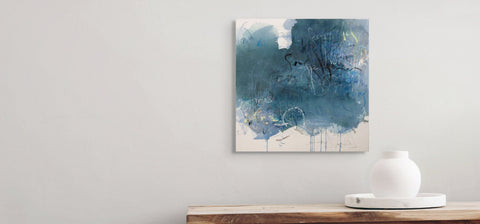
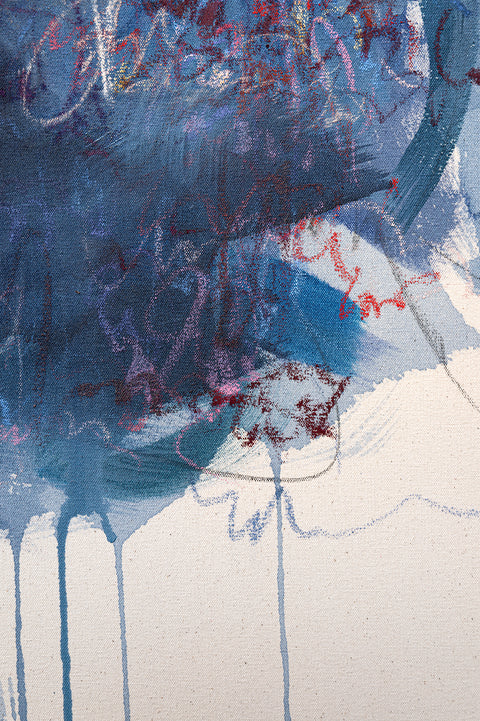
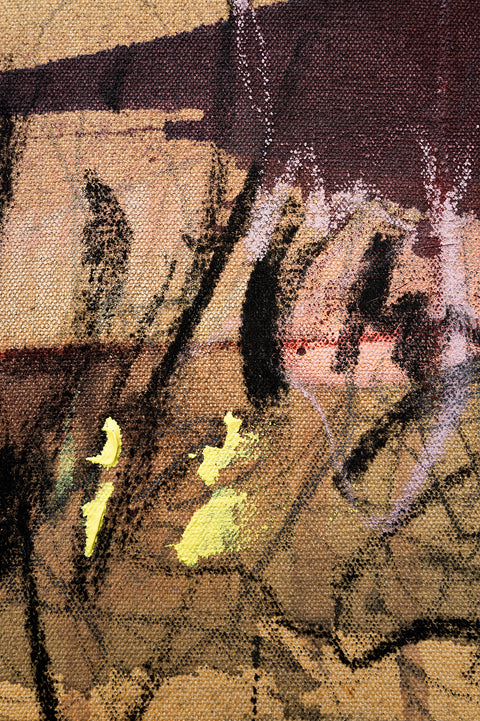
De Souza builds each piece through layering, erasure, and reworking, developing surfaces that hold the trace of what came before. At the heart of the work is her cut-out text technique: fragments harvested from existing texts are embedded within the painted surface, where letterforms shed their function and become form, rhythm, texture. Legibility hovers at the edge — enough to catch, not enough to hold.
As a painting develops, language often gives way entirely to asemic marks: gestures that carry the memory of writing without resolving into words. This is where the work opens up — the moment control releases into instinct, and the surface begins to speak on its own terms.
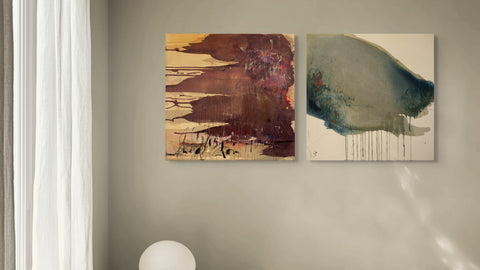
The works are quiet but not passive. Unified by a restrained palette, they shift with light and distance, revealing and concealing in equal measure. They ask for slow looking, and reward it.
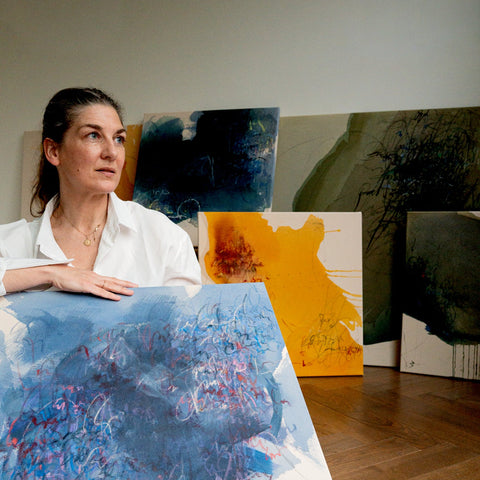
About the artist
Anika De Souza is a London-based abstract mixed media artist originally from Germany. With a background in graphic design and over a decade in the advertising industry, her practice centres on painting as a form of material and spatial inquiry.
Working with acrylic, graphite, oil stick, and dry media, De Souza builds layered compositions through mark-making that holds both discipline and instinct in tension. Central to her practice is a cut-out text technique — harvesting fragments from existing texts and embedding them within the painted surface to create concealed narrative elements. Language here is treated as material rather than message, dissolving into rhythm, texture, and spatial tension.
Her work explores the balance between articulation and silence, presence and absence, allowing space to function as an active element within the composition. She lives and works in Kingston Upon Thames.
De Souza has exhibited at The Other Art Fair, The Affordable Art Fair, Kingston Open Artist Studios, The Circle Gallery, and TAP Gallery (Turner Art Perspective Gallery), and her work has been featured in Times and Leisure.
"My practice investigates the interplay between language, material, and space. Drawing on my background in graphic design and calligraphy, I approach writing as a physical act, using gestural marks and structural forms to explore rhythm, movement, and texture. For me, language becomes material: I harvest fragments of text through a cut-out technique and embed them within layered compositions, where words stretch, blur, and fragment into abstraction.
This process shifts my focus from legibility to form, gesture, and spatial tension. My marks oscillate between control and spontaneity, while moments of absence – die Leerräume – function as active space, allowing the composition to breathe. Through this dialogue of presence and absence, accumulation and restraint, I invite the viewer to engage beyond language and experience the energy of gesture and the materiality of the surface.
I build my surfaces by combining expansive stains, layered media, and spontaneous marks with intentional interruptions, erasures, and voids. The result is a dynamic tension between order and disruption, structure and collapse. My work resists polished resolution, sustaining a restless dialogue in which rhythm, material, and space operate as both subject and medium."