Kirsty Tanner
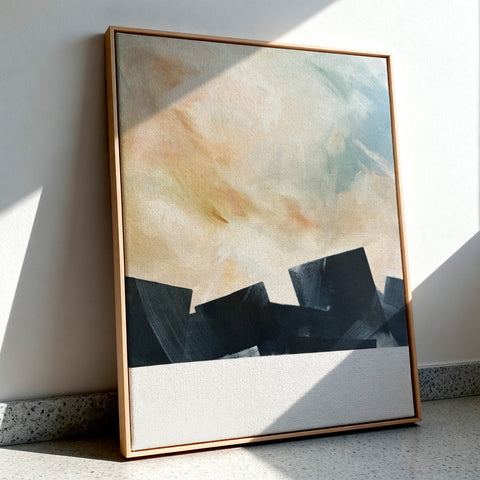
Kirsty Tanner paints the bits of sky and coast that stay with you long after you’ve walked away from them. Her Sky and Land Form series is all drifting cloud, wind-scuffed light and sharp navy shapes, interrupted by patches of bare white canvas that give every painting room to breathe.
Kirsty Tanner’s Sky and Land Form paintings start from memory. There are no preparatory sketches. She masks off sections of the canvas, then works fast with broad, flat strokes, layering acrylic paint and oil stick until a sky or a stretch of coast appears. It’s abstract landscape painting, but it feels oddly specific, like a place you’ve stood in even if you couldn’t say where.
Then comes the part that makes these paintings so recognisable. She unmasks the negative space, and bare white canvas slices through a bank of cloud or cuts a clean corner out of the sky. It interrupts the picture on purpose, and somehow the whole thing exhales. Ask Kirsty about the white space and you’ll get two answers. One is a nod to her graphic design training. The other is about how the world around us gets in the way of beautiful moments, like a building blocking a sunset or a walkway cutting across a horizon. Instead of painting those things in, she leaves them out. You get more space and a lot more calm.
The skies and shores are borrowed from places she’s lived and visited. Thirteen years on the east coast of Scotland gave her stormy, wild weather. Liverpool and the Mersey gave her big, open West Coast skies. Running through all of it is that very particular light bouncing and scuffing across wet rocks, and wind pushing cloud and grass around in the same split second.
The collection has two strands. Sky Form paintings are about a moment or a memory of sky. Land Form paintings bring in the solid stuff, like boulders, sea defences and harbour walls, in deep navy against softer, airier colour. There are six original paintings here, all acrylic and oils on canvas board in minimal wooden float frames. The smaller ones suit a shelf or a gallery wall, and the larger ones can hold a wall on their own. If you’re looking for contemporary abstract art for your home with a bit of Scottish coast and a lot of sky in it, start here.
About the artist
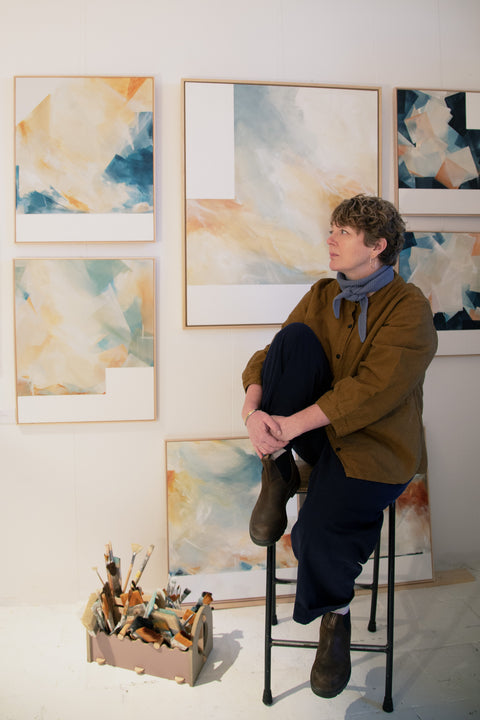
Kirsty Tanner is a Scottish artist, designer and maker, now living in Manchester. She works in paint, textiles and collage, and her subject is the world around her, both natural and built, and the way a moment or a memory of a place can stick.
Her paintings sit between two loves. One is the open land and sky of her rural Scottish childhood. The other is Modernist design and Brutalist architecture. You can see both at once, with soft, abstract weather held in place by strong architectural lines and generous negative space.
Kirsty’s work is held by a number of galleries around the UK, and she’s made paintings and textile pieces for private collectors.
“I first discovered Kirsty's work at the Affordable Art Fair and fell in love with her relationship to negative space. There is something so striking about the fluidity of the brush strokes against the graphic lines she creates. The composition is gratifying in a very unique way."

Artistic practice
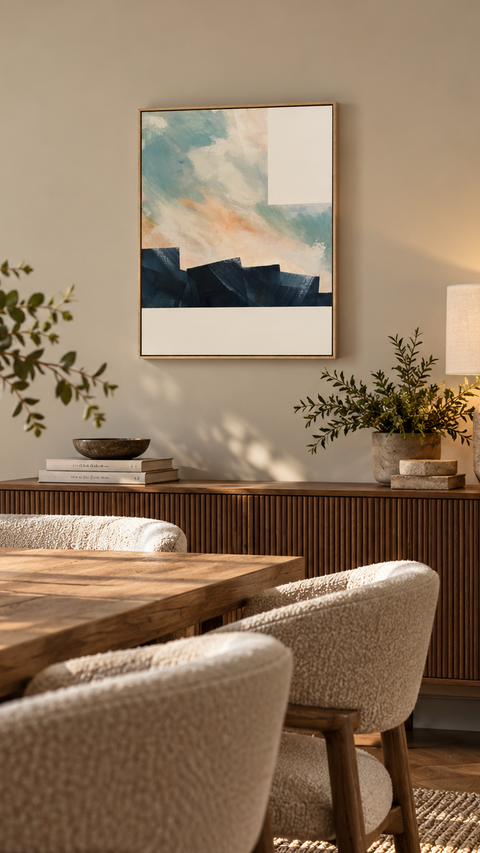
Kirsty’s current paintings grew out of a stretch of experimenting with mark making, masking, composition, pigment making and scale. She moves between processes, materials and techniques all the time, and she’d say that’s the point rather than a distraction.
She recently heard the artist Isabel Nolan talk about having an “urgency of curiosity” and recognised herself straight away. She needs to try things, and inspiration can come from anywhere. A discarded rusty hinge gets as much of her attention as a spectacular sunset. She loves finding out what a material can do, working with other craftspeople, and bringing her feel for line and colour to different projects.
A few themes keep turning up in the paintings. There are the clean graphic lines of Modernism, and the push and pull between nature and the built environment. And there’s her ongoing attempt to catch a fleeting moment, or the memory of a place, before it slips away.